
1:1 Part Scanning & 3D Printing — Fast and Precise
A cracked body bracket, a worn plastic clip, a metal mount from a motorcycle that went out of production years ago — sound familiar? Owners of vehicles, motorcycles, and industrial equipment frequently face the same challenge: the original part is unavailable, no aftermarket alternative fits, and without it the machine simply cannot run.
At DRUKEX, we solve this end-to-end: we 3D scan the original component, build an accurate digital model, and 3D print an exact 1:1 replica. You don’t need to visit our facility in Silesia — you can ship the part from anywhere in Poland.
In this article we walk through the entire workflow, explain which materials we use, give realistic lead times, and explain why this approach is becoming the go-to solution for automotive professionals, motorcycle restorers, and design engineers across Europe.
What Is Reverse Engineering and Why Does It Matter
Reverse engineering is the process of recreating a physical object in digital format through measurement, 3D scanning, and CAD modelling. In practical terms: we take your component, capture its geometry with a professional 3D scanner down to fractions of a millimetre, and produce an accurate digital twin from which any number of copies can be printed.
This workflow is especially valuable in the following scenarios:
- Discontinued parts — the manufacturer no longer produces the component and it cannot be sourced on the secondary market
- Disproportionate OEM pricing — dealer prices for a plastic clip or bracket are often difficult to justify
- Batch requirements — for example, restoring several vehicles simultaneously
- One-off or custom components — aftermarket tuning parts, classic cars, limited-edition motorcycles
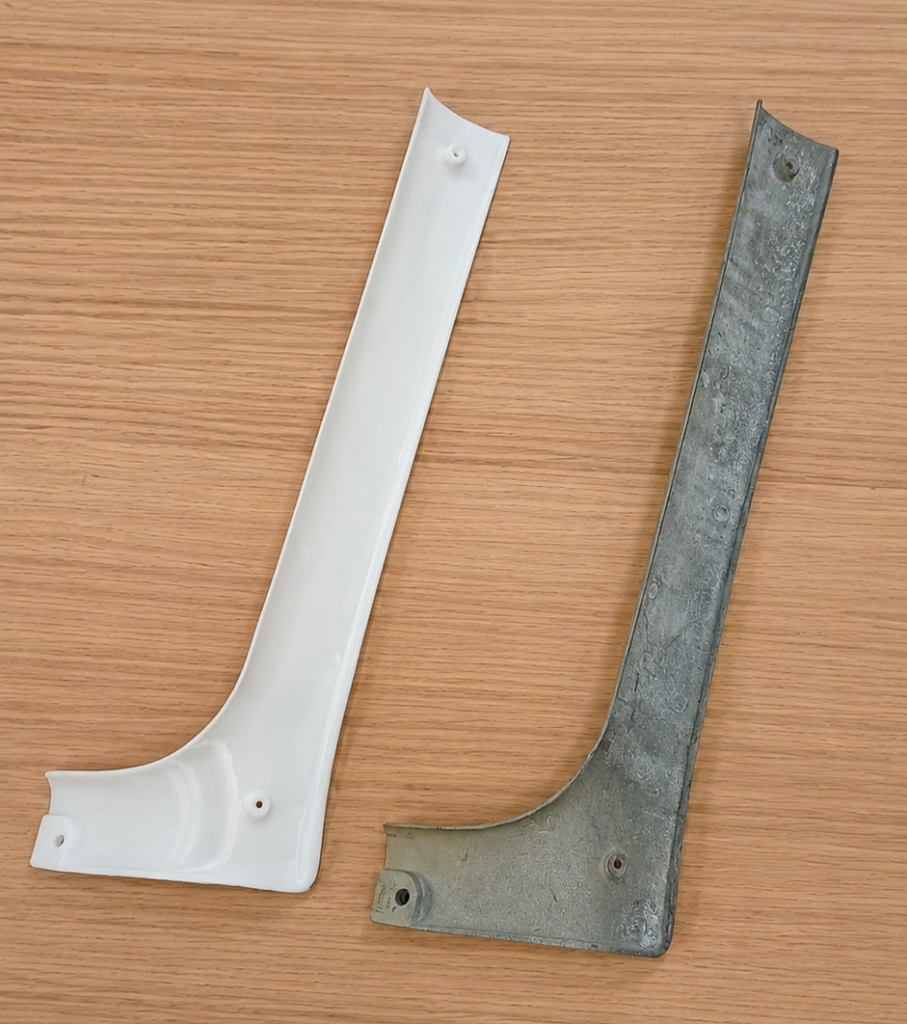
A typical example of our work: a worn L-shaped metal bracket with mounting holes alongside its 3D-printed replica. Both parts are geometrically identical, even though the original shows visible signs of corrosion and wear.
The Workflow: From Physical Part to Finished Replica
The process follows a clear, repeatable sequence that we have refined across hundreds of projects.
Step 1. Part Intake
You ship the original component to us by standard post or courier. We work with both plastic and metal parts — body panels, brackets, clips, trims, instrument housings, seals, fasteners, and more.
If you are based in Katowice, Chorzów, Bytom, Gliwice, or elsewhere in Upper Silesia, you are welcome to drop the part off in person at our workshop in Siemianowice Śląskie.
Step 2. 3D Scanning
Once we receive the part, we carry out professional 3D scanning using high-accuracy equipment. The scanner captures surface geometry to within a tenth of a millimetre — including all holes, fillet radii, draft angles, and surface texture.
The output is a dense point cloud or polygon mesh that faithfully represents the original geometry. At this stage we also check for warping or deformation and apply any necessary corrections to the model.
Step 3. CAD Model Preparation
The scan data is converted into a fully parametric CAD model in SolidWorks. This goes beyond simply copying the shape — it allows targeted design changes where needed, such as reinforcing a stress concentration, repositioning a hole, or adapting the geometry for a different material.
A parametric model also means we can reproduce the part in any quantity in the future without repeating the scanning process.
Step 4. Material Selection and 3D Printing
We select the optimal material based on the functional requirements of the part. For exterior and body components we most commonly use ASA or ABS — both offer excellent resistance to UV radiation, thermal cycling, and mechanical stress. For parts located in the engine bay or close to heat sources we recommend Nylon (PA12) or Polycarbonate (PC).
Printing is carried out using FDM technology with layer resolution from 0.1 mm. Lead times depend on part size and geometry, but the majority of standard components are ready within 1–3 business days of scan approval.
Step 5. Post-Processing and Dispatch
The finished part is inspected against the original, surface-finished where required, and dispatched together with the original component. You receive both back.
What Parts Can We Replicate
Requests come from a wide range of sectors. Below are the most common part categories we work with.
Automotive Parts
- Body brackets and mounting hardware
- Plastic clips, blanking plugs, and trims
- Mirror housings and door handles
- Interior components (trim panels, frames, holders)
- Bumper and sill fasteners
- Cooling and ventilation system components
Motorcycle Parts
- Fairing and bodywork components
- Headlight and indicator brackets
- Seat and tank mounts
- Protective covers and guards
- Exhaust and cooling system parts
Industrial and General Engineering Parts
- Furniture components and hardware
- Instrument and equipment housings
- Mounting brackets and supports
- Agricultural machinery components
- Window, door, and enclosure hardware
If your part does not fall neatly into any of these categories, get in touch. In the vast majority of cases the answer is yes, we can replicate it.
Materials We Use and Why Material Selection Matters
Choosing the right material is one of the most critical factors in achieving a successful result. An incorrectly specified polymer can lead to premature failure under load or thermal deformation after a single season outdoors.
Full details of all available materials are available on our materials page. Below is a practical overview of the most relevant options for replacement part applications.
ASA — The Preferred Choice for Exterior Components
ASA (Acrylic Styrene Acrylonitrile) is an engineering polymer specifically developed for outdoor applications. Key properties:
- Excellent UV resistance — does not yellow or become brittle under prolonged sun exposure
- Good mechanical strength
- Thermal stability from −20 °C to +90 °C
- Easy to machine and paint
ASA is our default material for body parts, exterior brackets, and any component exposed to the elements.
ABS — The Proven Engineering Standard
ABS (Acrylonitrile Butadiene Styrene) is the established workhorse of technical 3D printing. It is slightly less UV-stable than ASA, but offers excellent impact resistance and responds well to machining, sanding, and bonding. Ideal for interior components and exterior parts with adequate sun protection.
Nylon — For High-Load Applications
Nylon (PA12) delivers outstanding wear resistance and fatigue performance. It is the material of choice for components subject to cyclic loading, vibration, or friction — bushings, gears, suspension brackets, and similar demanding applications.
PETG — The Versatile All-Rounder
PETG combines ease of printing with solid mechanical properties and good chemical resistance. Well suited for parts in contact with technical fluids and components with moderate structural requirements.
The Advantages of Shipping Your Part by Post
One of the most practical aspects of our service is that there is no need to travel. We serve clients across the whole of Poland — from Warsaw to Gdańsk, from Wrocław to Rzeszów.
How the remote workflow operates:
- Contact us — describe the part, send photos, receive a preliminary cost estimate
- Ship the part — by standard post or courier to our address in Siemianowice Śląskie
- We scan and confirm — we send you the 3D model for approval before printing begins
- We print and dispatch — you receive both the original and the replica
Standard turnaround from receipt of part: 3–5 business days. Expedited processing is available on request.
A Key Advantage: Your Digital Model Is Stored Permanently
This is arguably the most strategically important aspect of the service — and one that is easy to overlook at first. Once we have scanned and modelled your component, the digital file is retained in our database indefinitely.
What this means in practice:
- Order one part today — and ten more in twelve months with no repeat scanning
- No need to store a worn original — the digital model is more accurate and does not corrode
- Batch production on demand — ideal when restoring multiple vehicles or building a spare parts inventory
- Design iteration is straightforward — reinforce a weak area or adapt geometry at any time
For workshops and manufacturing businesses this is particularly valuable: small-series production of replacement parts from a single scan represents a genuine long-term saving in both time and cost.
Dimensional Accuracy and Quality
A common question is how closely the printed part matches the original. The answer depends on several factors, but as a general benchmark we deliver:
- Dimensional accuracy: ±0.1–0.2 mm for the majority of components
- Geometric fidelity: all radii, draft angles, and surface features reproduced from scan data
- Fastener holes: toleranced to accommodate standard hardware
- Surface finish: post-processing carried out where aesthetic quality is required
For components requiring tighter tolerances — bearing seats, seal interfaces — we recommend a combined approach: 3D printing followed by CNC machining or milling.
It is also worth noting that a plastic replica of a metal part is not necessarily an inferior solution. In many applications, polymers such as Nylon or ABS handle the required loads perfectly well, while offering a weight reduction and complete corrosion immunity.
Who Benefits Most from This Service
Classic Car and Vintage Motorcycle Owners
Sourcing parts for a 1970s automobile or a limited-production motorcycle can be an exercise in frustration. 3D scanning and rapid prototyping make it possible to replicate any component from an existing original — even if that original is in poor condition.
Automotive Workshops and Bodyshops
If you regularly restore vehicles or carry out body repair work, the ability to source any non-standard part within 3–5 days significantly extends the range of jobs you can take on.
Industrial and Manufacturing Businesses
A failed component on a production line can halt an entire facility. Fast 3D scanning and printing of a functional replacement is often the only way to restore operations without waiting weeks for an OEM spare.
Design Engineers and Prototyping Teams
If you need a prototype or functional mockup based on an existing component, reverse engineering provides a precise, dimensionally accurate starting point for further development.
Pricing and Lead Times: What to Expect
Cost depends on:
- Part size — smaller components are faster and less expensive to scan and print
- Geometric complexity — straightforward forms are processed more quickly
- Material choice — Nylon and PC carry a higher material cost than PETG or PLA
- Quantity — batch printing significantly reduces the per-unit cost
Indicative lead times:
- Scanning and CAD modelling: 1–2 business days
- Printing a standard component: 1–3 business days
- Total turnaround from receipt to dispatch: 3–5 business days
For an accurate quote, use our online request form. A brief description of the part and a few photographs are sufficient to get started.
Conclusion: 3D Scanning + 3D Printing = A Second Life for Any Component
The combination of professional 3D scanning, reverse engineering, and additive manufacturing opens up possibilities that would have seemed implausible a decade ago. A discontinued, broken, or simply unavailable part is no longer an obstacle.
Every day at DRUKEX we receive shipments from across Poland — worn body brackets, rare vintage motorcycle components, obsolete industrial hardware. And every day we dispatch precise, ready-to-fit replicas back to their owners.
Ship us your part — we will replicate it accurately, quickly, and reliably.
Complete the form on the quote page or reach us through the contact page — describe your component and we will recommend the optimal solution.