
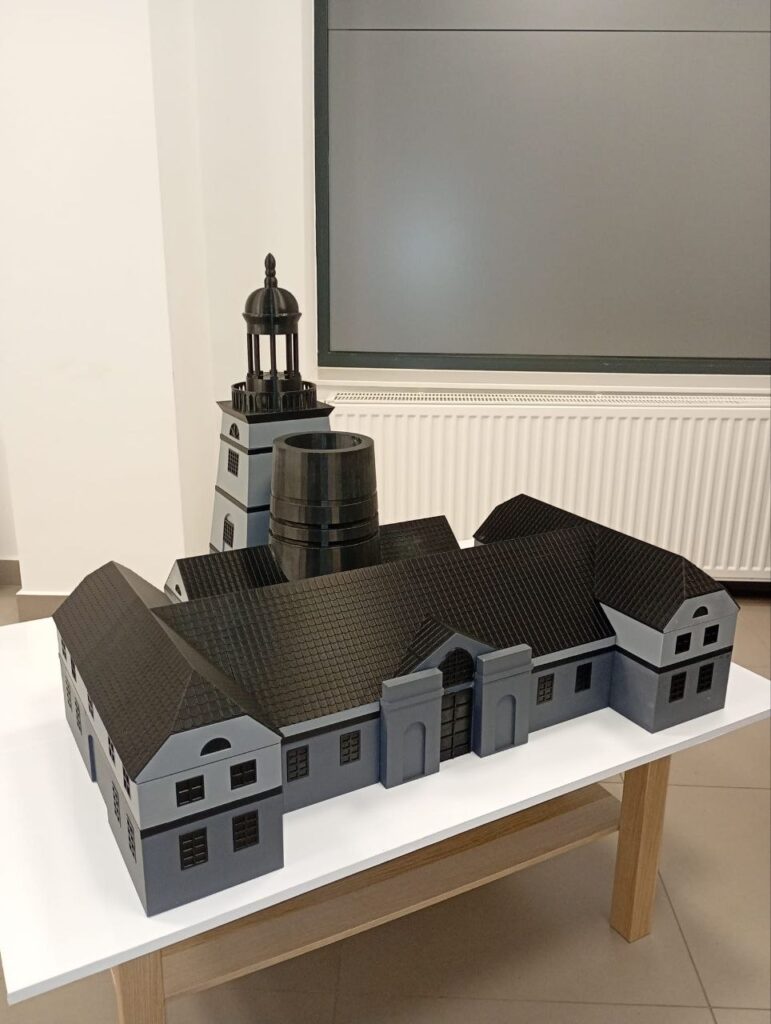
1200×900 mm Architectural Scale Model: Outdoor-Ready 3D Printing in ASA
When the client arrived at DRUKEX with a bundle of archival photographs and said, “I need this displayed outside permanently” — we immediately understood this would be a complex but exceptionally rewarding project. The result was a detailed architectural scale model with a 1200×900 mm footprint, 3D printed in ASA material and fully engineered for permanent outdoor exposure. In this article we explain our design approach, why we selected ASA over competing materials, and how we organised delivery to a client located in a different region of Poland.
From Archival Photograph to Digital Model
The project did not begin with a ready-made CAD file. Instead, our starting point was a set of historical photographs — black-and-white images taken from various angles and at varying quality levels. This is one of the most demanding input formats for an engineer: no precise dimensions, no technical drawings, only visual information.
Our design engineer carried out full reverse engineering of the building’s geometry in SolidWorks: reconstructing proportions, tower heights and profiles, cornice details, and a roof surface with simulated roof-tile texture — all derived from photographic references. Every facade element — arched windows, decorative gables, balustrades — was modelled individually and then integrated into the master assembly.
This workflow demands not only advanced CAD design skills in SolidWorks, but also genuine architectural knowledge: understanding the stylistic conventions of the period, the logic of structural elements, and the typical proportions of historical buildings. Without this background, a convincing reconstruction is simply not possible.
Structure of the Digital Assembly
The final model consisted of several dozen individual parts, grouped into logical modules:
- Main body — the central section of the building with a gabled roof
- Side wings — symmetrical extensions with independent roof structures
- Tower with dome — the principal vertical feature with a lantern at the apex
- Decorative elements — cornices, pilasters, and window surrounds
- Base platform — the structural plate that unifies all components
Every part was designed with tolerances for adhesive bonding and mechanical interlocking, so that the assembled model would appear monolithic with no visible gaps or seams.
Why ASA and Not PLA or ABS?
Material selection for outdoor display is not a matter of preference — it is a question of long-term durability. Here is why ASA (Acrylonitrile Styrene Acrylate) was the right choice for this project.
The Core Problem with PLA Outdoors
PLA is an excellent material for interior models: easy to print, capable of sharp detail, available in hundreds of colours. However, under direct sunlight PLA begins to deform at just +50–60 °C — a temperature that a dark surface in summer sunshine can easily reach. In addition, PLA degrades under UV radiation: it yellows, becomes brittle, and loses mechanical strength over time.
Limitations of ABS for Exterior Use
ABS tolerates higher temperatures (approximately 100 °C) and handles mechanical stress better than PLA. However, it has a significant drawback for outdoor applications — poor UV resistance. Without an additional protective coating, ABS exposed to the elements quickly fades and becomes brittle.
Why ASA Is the Right Choice for Outdoor 3D Printing
ASA was developed specifically as an outdoor-grade alternative to ABS. Its key characteristics:
| Property | PLA | ABS | ASA |
|—|—|—|—|
| Heat resistance | ~60 °C | ~100 °C | ~100 °C |
| UV resistance | ❌ Low | ❌ Low | ✅ High |
| Weathering resistance | ❌ | ⚠️ Moderate | ✅ High |
| Print detail quality | ✅ | ✅ | ✅ |
| Print complexity | Easy | Moderate | Moderate |
ASA retains both colour and mechanical properties under prolonged exposure to sun, rain, frost, and thermal cycling. This is precisely why it is widely used in the automotive industry for exterior components — and precisely why we selected it for this scale model.
For a full overview of available 3D printing materials, visit our materials page.
Print Technology: Large-Format FDM 3D Printing
A model with a 1200×900 mm footprint is a large-format object even by industrial 3D printing standards. No standard FDM printer has a build volume of this size, so the model was produced as a series of modular parts and assembled after printing.
Print Parameters
- Technology: FDM (Fused Deposition Modelling)
- Material: ASA in two colours — light grey (walls) and dark grey / anthracite (roof, tower)
- Layer height: 0.15–0.2 mm — balancing surface detail with print time
- Infill density: 20–30% for solid decorative elements; 40%+ for load-bearing nodes
- Number of parts: several dozen individual components
Challenges of Large-Format ASA Printing
ASA is a demanding material to process. It has a pronounced tendency to warp during cooling, particularly across large flat surfaces. To minimise this effect we:
- Printed in an enclosed, temperature-controlled chamber
- Applied adhesion-enhancing coatings to the print bed
- Divided large components into smaller segments with overlapping joints
- Carefully managed cooling fan speed to control the thermal gradient
The outcome was a set of warp-free parts with flat surfaces and sharp, well-defined edges.
Assembly and Finishing
Once all components were printed, the model moved into the assembly phase. Parts were joined using interlocking mechanical joints and structural adhesive; seams were sanded and smoothed. The two-colour scheme — light grey walls combined with a dark roof — was achieved entirely at the printing stage, with no painting required. This approach guarantees long-term colour stability that a painted surface cannot match.
The finished model is realistic, elegant, and highly legible in its architectural detail: tile texture, profiled window surrounds, and decorative facade elements are all clearly visible.
Nationwide Delivery: How We Package Large-Format 3D Printed Parts
One of DRUKEX’s key strengths is that we work with clients across the whole of Poland, not only within the Silesia region. This project is a clear example: the client was based in a different voivodeship, and the finished model had to arrive intact.
Large-format and fragile 3D printed objects require a purpose-built packaging approach:
- Every section of the model was wrapped in polyethylene foam film
- Sections were secured in rigid cardboard inserts inside the outer box
- Voids were filled with expanded polystyrene granules for shock absorption
- The outer packaging used a wooden crate for especially large consignments
The model arrived at its destination without a single point of damage — which, for an object measuring over one metre across, is a meaningful indicator of logistics quality.
> We deliver to clients across Poland. Whether you are based in Warsaw, Kraków, Gdańsk, or Wrocław — we will organise reliable delivery of your order.
Applications for Large-Scale Architectural Models
Large-format architectural scale models produced by 3D printing find applications across a wide range of sectors in the B2B market:
Museums and Public Exhibitions
A physical scale model offers visitors something that even the most sophisticated digital visualisation cannot — tactile engagement with an object, the ability to examine it from every angle, and an immediate sense of scale. For regional history museums, heritage exhibitions, and memorial sites, a well-crafted physical model is an irreplaceable exhibit.
Outdoor Information and Tourism Installations
Scale models installed in outdoor environments — alongside churches, castles, and town halls — serve as tourist attractions and interpretive elements. ASA material ensures a long service life with no requirement to bring the model indoors during winter months.
Architectural Design and Real Estate Development
For investor presentations or community consultations, a physical model of a proposed building communicates far more effectively than slides or renderings alone. A large-format model allows stakeholders to examine facade details, site layout, and contextual relationships at a glance.
Heritage Documentation and Restoration
When an original building has been demolished or significantly altered, a 3D-printed scale model reconstructed from archival sources becomes a documentary record of its original appearance. This application is particularly relevant in Upper Silesia, with its rich industrial and architectural heritage.
Why Commission DRUKEX?
DRUKEX is a company based in Silesia (Siemianowice Śląskie) that combines engineering expertise with industrial production capability to deliver complex, non-standard projects.
Our Strengths for Projects Like This:
In-house CAD design — we do not simply print files supplied by clients; we create geometry from scratch, including from archival photographs and hand sketches.
Wide material range — from PLA for interior display models to ASA, PC, and Nylon for industrial and outdoor applications.
Large-format 3D printing — we realise objects of any size through modular printing and precision assembly.
Experience in low-volume production runs — if you need several identical models for multiple locations, we can organise a short production series.
Poland-wide delivery — robust packaging and trusted logistics partners as standard.
Project Technical Specifications
| Parameter | Value |
|—|—|
| Base dimensions | 1200 × 900 mm |
| Material | ASA (two colours) |
| Technology | FDM 3D printing |
| Layer height | 0.15–0.2 mm |
| Intended use | Permanent outdoor display |
| Model source | Reverse engineered from archival photographs |
| Number of parts | Several dozen modular components |
| Delivery | Nationwide across Poland |
Have a Similar Project?
Whether you have a finished CAD file ready to print or nothing more than an old photograph and an idea — the DRUKEX team can take your project from initial concept through to a finished, production-ready part. We work with B2B and B2C clients throughout Poland.
Browse our portfolio of completed projects or go straight to our quote request form — we respond within 24 hours and will propose the most efficient solution for your specific requirements.
DRUKEX — 3D Printing and CAD Design, Silesia and all of Poland.