
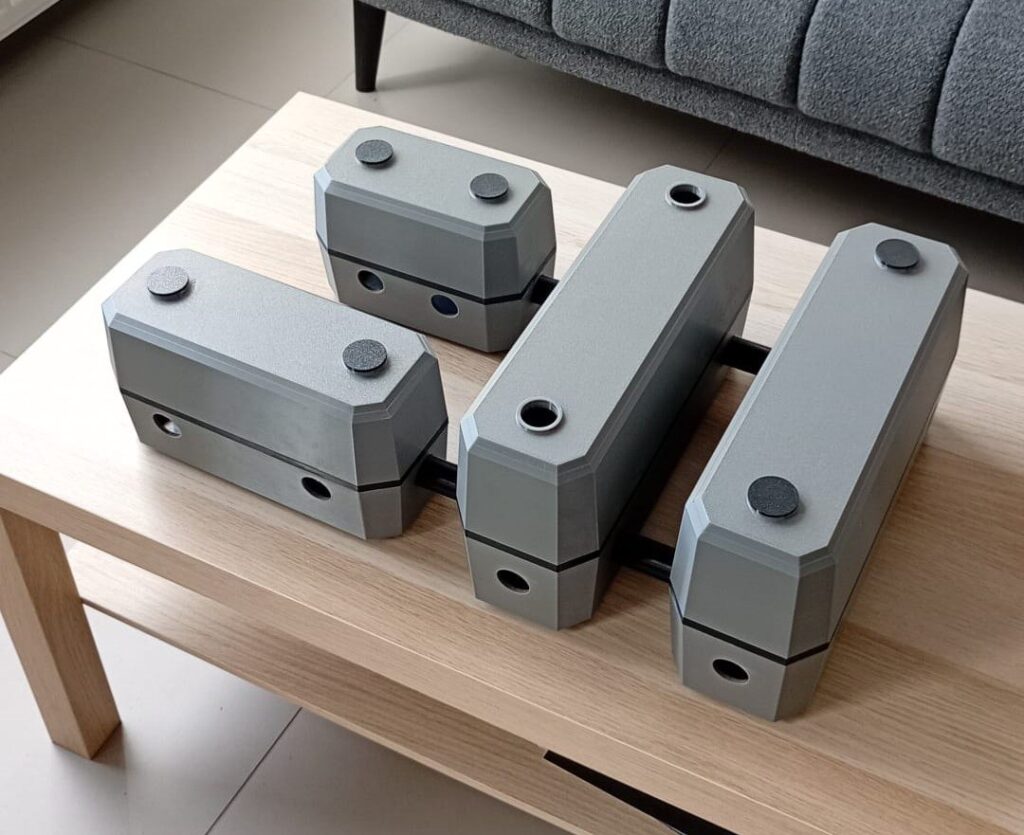
3D Printed Tank Models for Trade Shows and Industrial Exhibitions
Exhibition models occupy a unique space where engineering precision meets presentation aesthetics. When a client approached us with a brief to produce scale models of interconnected industrial tanks and pipelines, we treated it as a full end-to-end project — from CAD design through to final 3D printing and finishing. The result was a compelling demonstration model that accurately conveys the functional logic of a real liquid storage system.
In this article, we walk through how we delivered this project, which technologies and materials we selected, and why 3D printing is the optimal solution for trade show and demonstration models in the industrial B2B sector.
What Is an Exhibition Model and Why Does It Matter?
An exhibition or demonstration model is a scale or full-size replica of a real object, created for trade shows, showrooms, client negotiations, or training events. Unlike a functional rapid prototyping output, an exhibition model does not need to be operational — but it must be visually and tactilely convincing.
For companies that manufacture or supply industrial equipment — tanks, vessels, pipeline systems — having a high-quality physical model on a stand or in a meeting room significantly increases credibility with potential partners and clients. No on-screen 3D visualisation can replicate the impact of holding a real object in your hands.
Why Not Traditional Manufacturing?
Traditional production of exhibition models from metal, wood or cast plastic is expensive and time-consuming. For one-off or short-run orders, it is rarely economically viable. FDM 3D printing offers a practical alternative:
- Faster turnaround — from several weeks down to a matter of days
- Significantly lower unit cost compared to CNC machining or injection moulding
- Complex geometry made easy — curved surfaces, internal channels, connecting elements
- Simple design iterations — if the client wants to adjust the scale or layout, only the CAD file needs updating
Project Overview: Industrial Tank System Model
The client — a company operating in the industrial sector — commissioned a demonstration model of a tank system with interconnected pipelines. The model was intended for a trade show stand and client-facing presentations.
Client Requirements and Project Brief
The DRUKEX team was tasked with the following:
- Develop or adapt a CAD model of the tank system based on the client’s technical data
- Ensure a modular construction — tanks connected by detachable pipe sections
- Select a material providing rigidity, dimensional accuracy and a professional finish
- Deliver the model within a tight deadline ahead of the exhibition
We took the project into production and, during the CAD design phase in SolidWorks, proposed several technical approaches to achieve reliable modular connections.
Design: From Brief to CAD Model
Designing exhibition models in SolidWorks has its own specific demands. Unlike functional parts, the key priorities here are:
- Choosing the right scale — the model must be large enough to make an impression while remaining compact for transport
- Designing connection interfaces between modules (pipes and tanks) with tolerances that account for FDM material shrinkage
- Splitting large components into printable sections — respecting the build volume of the printer and selecting optimal print orientation
- Surface aesthetics — correct part orientation minimises visible layer lines on presentation-facing surfaces
The tank system model consisted of several core components: cylindrical tank bodies, connecting fittings, pipe sections of varying lengths, and a mounting base. Each component was modelled as a separate SolidWorks file and then brought into an assembly to validate part interaction and fit.
Material Selection for Exhibition Models
Choosing the right material for an exhibition model means balancing rigidity, surface quality, post-processing ease, and cost.
PETG — The Optimal Choice for Demonstration Models
For this project, we selected PETG (polyethylene terephthalate glycol) — one of the most widely used materials for functional and display applications. Here is why:
- High rigidity with impact resistance — the model will not crack during transport or handling
- Minimal warping compared to ABS — critical for dimensional accuracy at connection interfaces
- Good surface quality — PETG produces a smoother surface than PLA, simplifying sanding and painting
- Chemical resistance — the model is unaffected by contact with lubricants or mild solvents during post-processing
- Cost efficiency — important when producing multiple identical models for different exhibition venues
For a full overview of materials available for 3D printing, visit our 3D printing materials page.
Alternatives: ABS and ASA Materials
For clients requiring higher temperature resistance or the option of acetone vapour smoothing, we offer ABS as an alternative. ASA is particularly well-suited when the model will be used outdoors or exposed to UV light — ASA materials deliver excellent weathering resistance without surface degradation. Our team advises on material selection as part of the quoting process for every project.
3D Printing Technology: FDM for Exhibition Models
FDM (Fused Deposition Modelling) is our primary production technology and is ideally suited to mid- and large-scale exhibition models.
Print Parameters for Maximum Quality
For exhibition models, we apply specific print settings:
- Layer height 0.15–0.20 mm — delivers strong detail without excessive print time
- Infill 20–30% — sufficient rigidity for a display model not subject to mechanical load
- 3–4 perimeter walls — for structural strength and a high-quality outer surface
- Nozzle and bed temperature — optimised per material and component geometry
Part orientation was selected individually for each component: cylindrical tank bodies were printed vertically for optimal surface quality; connecting fittings were oriented horizontally for precise bore accuracy.
Post-Processing: From the Printer to the Exhibition Stand
After printing, all parts go through a structured post-processing workflow:
- Support removal — careful removal of support structures without surface damage
- Sanding — progressive sanding of presentation surfaces (240 → 400 → 800 grit)
- Priming — acrylic primer applied to level the surface and improve paint adhesion
- Painting — final coating in the client’s corporate colours or standard industrial tones (grey, blue, yellow)
- Assembly — modules connected, fit quality checked, final inspection completed
The result is an exhibition model that reads as a scaled-down replica of real industrial equipment.
Modularity as a Core Advantage
One of the most valuable features of this project was the modular construction of the system. Tanks connect to pipe sections via standardised interfaces, enabling the client to:
- Reconfigure the layout directly on the trade show floor — demonstrating different connection schemes to different audiences
- Transport the model disassembled without risk of damage
- Expand the system with new elements — for example, adding a pump unit or valve assembly for a future exhibition
- Reuse the model long-term — this is not a single-use asset
Modularity is achieved through precise tolerances in the connection elements. In SolidWorks, we designed clearance fits with 0.3–0.5 mm gaps for sliding connections and 0.1–0.2 mm for press fits — calibrated to the characteristics of PETG on our specific printer fleet.
If you are interested in 3D prototyping or demonstration models for your business, we are ready to discuss the technical details.
3D Printing for Trade Shows: Common Industrial Applications
The tank system project is one example of the exhibition models we produce for industrial clients. Other typical applications include:
Mechanical Engineering and Heavy Industry
- Scale models of machine tools, presses and lifting equipment
- Cut-away demonstration models showing internal construction
- Component and assembly models for personnel training
Energy and Chemical Processing
- Pipeline system and pumping station models
- Refinery and process plant layouts
- Demonstration models of heat exchangers and separators
Construction and Infrastructure
- Architectural models of industrial facilities
- Engineering network models for investor presentations
- Display samples of structural components
For all of these applications, DRUKEX offers a complete service: from design to finished model. Browse examples of our work in the project gallery.
Lead Times and Pricing for Exhibition Models
The most common questions from clients: how much does an exhibition model cost, and how long does it take?
Typical Lead Times
For mid-complexity projects such as the tank system described here:
- CAD design: 2–5 business days depending on complexity and availability of source data
- 3D printing: 1–3 days for a full set of parts
- Post-processing and painting: 2–4 days
- Total lead time: 5–12 business days from sign-off on the technical brief
When a complete CAD model is provided by the client, lead times reduce to 3–7 business days.
Factors Affecting Cost
- Overall size and number of components
- Geometry complexity and support structure requirements
- Material selection
- Post-processing and painting specification
- Urgency of delivery
For an accurate quote, use our online quote request form — provide dimensions, material preference and required delivery date, and we will send a commercial proposal within 24 hours.
Why DRUKEX for Industrial Exhibition Models
We are based in Siemianowice Śląskie and serve clients across Poland, with particularly strong ties to industrial businesses throughout Upper Silesia — Katowice, Gliwice, Bytom, Sosnowiec and the wider region.
Our key strengths for exhibition model projects:
In-house design capability — no need to source a separate CAD engineer. We take projects from a sketch or technical description through to a finished model. Learn more about our 3D printing services in Katowice and the region.
Broad material range — FDM production in ABS, PETG, PLA, ASA, Nylon, TPU and PC allows us to match the right material to every project requirement.
Quality control — every part is inspected after printing and post-processing. We guarantee conformance to the approved drawing.
Scalability — from a single rapid prototype to a short run of identical models for a network of showrooms.
Industrial B2B experience — we understand the B2B environment: documentation requirements, approval workflows and the hard deadlines that come with exhibition schedules.
Summary: Investing in First Impressions
An exhibition model is an investment in the first impression you make. A well-crafted physical model of your product or system on a trade show stand communicates more than any brochure. It allows potential clients and partners to literally hold your product, feel its scale and understand its complexity.
3D printing has made this kind of model accessible to mid-sized businesses — without the significant capital outlay of traditional manufacturing and without waiting months for delivery.
The DRUKEX team is ready to deliver your next exhibition model project — from simple display samples to complex modular layouts of industrial systems.
Have an upcoming trade show or client presentation? Get in touch as early as possible — we will help you meet your deadline and budget. Complete our quote request form or reach us via the contact page — we respond within one business day.