
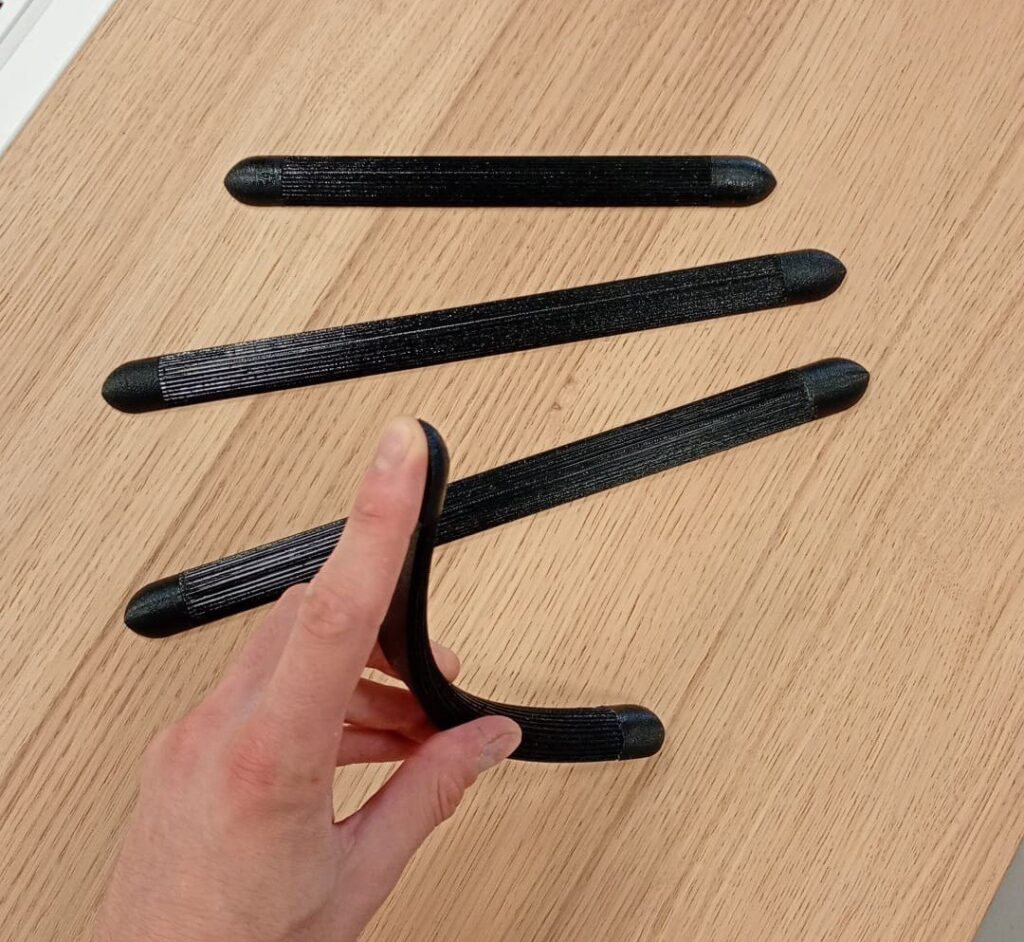
TPU 3D Printing: Custom Seals, Equipment Feet and Anti-Slip Components
When an off-the-shelf rubber gasket doesn’t match your geometry and cutting a mould costs thousands, TPU 3D printing becomes the most practical solution for engineers, product designers and manufacturing businesses. Flexible parts in any geometry, ready within days — that’s the reality of modern rapid prototyping and low-volume production.
At DRUKEX, we regularly produce TPU parts ranging from simple equipment feet and furniture pads to complex seals with non-standard cross-sections. This article explains why TPU is a uniquely versatile material, where it delivers the most value, and how to prepare your project for the best possible result.
What Is TPU and How Does It Differ from Other 3D Printing Materials
TPU — thermoplastic polyurethane — is an elastomer that combines the properties of rubber and rigid plastic. Unlike standard FDM filaments such as PLA, PETG or ABS/ASA materials, TPU returns to its original shape after deformation. This elastic recovery makes it indispensable across a wide range of industrial and commercial applications.
Key Technical Properties of TPU
Shore hardness is one of the most important parameters when selecting a TPU grade. The most common options are:
- Shore 85A — very soft, rubber-like feel, excellent vibration and impact damping
- Shore 90A — medium hardness, the universal choice for most applications
- Shore 95A — firmer, retains shape under load, suited to functional structural parts
Beyond elasticity, TPU also offers:
- Outstanding abrasion resistance — 3–5× better than standard thermoplastics
- Chemical resistance to oils, greases and many industrial fluids — critical for manufacturing environments
- Wide operating temperature range — from −40 °C to +80 °C depending on grade
- Natural grip and anti-slip surface — inherent high coefficient of friction
- Tear and cut resistance — the material stretches rather than rupturing suddenly
Our 3D printing materials page provides a detailed comparison of TPU against other filaments we use in production.
Where TPU Is Irreplaceable: Key Industrial Applications
The flexibility of TPU opens up a broad range of practical use cases — particularly where rigid plastics simply cannot perform.
Custom-Profile Industrial Seals
This is arguably the strongest use case for TPU in 3D printing. Industrial seals and gaskets are traditionally manufactured by extrusion or injection moulding — both methods require expensive tooling and minimum order quantities in the thousands. TPU 3D printing eliminates both barriers.
With 3D printed TPU seals you can specify:
- Any cross-section geometry — round, square, L-shaped, or complex custom profiles
- Any length or configuration — straight runs, corners, full frame seals
- Quantities from a single piece — ideal for prototyping, equipment repair or bespoke production
- Dimensional accuracy of ±0.2 mm — sufficient for the majority of sealing applications
Typical orders we fulfil include: door seals for industrial enclosures, lid gaskets for tanks and vessels, and custom interface seals for non-standard pipe connections.
Equipment Feet and Vibration Isolation Pads
Elastic equipment feet are another high-demand TPU application. The material works on several levels simultaneously:
- Vibration damping — essential for compressors, pumps, machine tools and audio equipment
- Floor surface protection against scratching and marking
- Anti-slip performance — TPU’s natural grip ensures stable positioning on any surface
- Micro-level surface compensation — a flexible foot conforms to minor floor irregularities
A key advantage is that we can print a foot precisely matched to the mounting interface of your specific product — with the correct thread diameter, flange geometry or fixing feature integrated directly into the part.
Anti-Slip Grips, Overlays and Inserts
TPU is an excellent choice for anti-slip components: handle grips for tools and equipment, jaw inserts for robotic manipulators, and isolation pads for machinery. The material delivers a coefficient of friction comparable to rubber while maintaining the precise geometry defined in the 3D model — something moulded rubber profiles rarely achieve for non-standard shapes.
Protective Edge Bumpers and Corner Guards
Protecting edges and corners on equipment, vehicles or furniture is another natural application for TPU. Unlike standard soft-PVC edge profiles, 3D printed bumpers can follow complex geometries that precisely match the contours of a specific product.
Functional Prototypes for Elastic Components
Before committing to injection moulding tooling for rubber or polyurethane parts, printing a functional prototype in TPU allows you to validate fit, function and ergonomics at near-zero tooling cost. Our 3D prototyping page covers this workflow in more detail.
TPU FDM Printing: Process Considerations
Printing with TPU is technically more demanding than working with rigid filaments. The flexible filament is prone to buckling in the extruder feed path, requiring specific printer configurations and experienced operators.
Why Not Every Service Bureau Prints TPU Well
The main challenges when 3D printing TPU include:
- Reduced print speed — TPU requires slow extrusion (20–35 mm/s versus 60–80 mm/s for PLA); at higher speeds the filament compresses and jams
- Retraction settings — excessive retraction causes blockages; precise tuning is essential
- Bed adhesion — TPU can adhere too strongly or too weakly depending on surface temperature
- Post-processing — elastic parts are more difficult to finish mechanically
At DRUKEX, we maintain validated print profiles for multiple TPU grades and Shore hardness levels. This allows us to produce consistently high-quality parts, free from the defects that are common when TPU is printed without the right process knowledge.
Part Orientation on the Build Plate
For flexible components, build orientation is critical. FDM creates an anisotropic layer structure — strength along the layer direction differs significantly from inter-layer strength. For seals and equipment feet, we orient parts so that primary loads act along the layer planes rather than trying to delaminate them.
Infill Density and Pattern for Flexible Parts
Infill percentage directly controls the effective stiffness of a TPU part:
- 15–25% infill — maximum softness, ideal for cushioning and damping pads
- 40–60% infill — balanced stiffness, the standard choice for feet and seals
- 80–100% infill — firm, spring-like behaviour for load-bearing functional parts
Selecting the optimal infill for each application is part of our standard pre-production workflow.
From Concept to Finished Part: How We Work
Ordering custom TPU parts from DRUKEX is straightforward — even if you don’t have a ready-made 3D model.
Step 1: Technical Brief or Sketch
Simply send us:
- A ready STL or STEP file
- A dimensioned sketch or technical drawing
- Or even a photo of the original part you need to replicate or adapt
If you don’t have a 3D model, our engineering team will handle CAD modelling in SolidWorks. We regularly design seals, feet and other flexible components from scratch based on client sketches — including reverse engineering of existing parts.
Step 2: Material Parameter Selection
We will confirm with you:
- Required Shore hardness
- Operating conditions — temperature range, chemical exposure, mechanical load
- Surface finish and appearance requirements
- Required quantity
Step 3: Production and Quality Control
Every batch undergoes visual inspection and, where appropriate, functional testing. For seals we verify geometry with a micrometer; for equipment feet we check height consistency and mounting interface fit.
Step 4: Delivery Across Poland
DRUKEX is based in Siemianowice Śląskie and serves clients throughout Poland. Most orders are dispatched by courier within 2–5 business days of file approval. Clients from Katowice and the Silesia region are also welcome to collect in person.
When TPU 3D Printing Outperforms Traditional Methods
A direct comparison with the alternatives shows clearly when additive manufacturing is the right choice.
TPU 3D Printing vs. Injection Moulding
| Parameter | TPU 3D Printing | Injection Moulding |
|—|—|—|
| Minimum order quantity | 1 piece | 500–5,000 pieces |
| Tooling cost | €0 | €1,200–€12,000+ |
| Lead time to first part | 1–3 days | 4–8 weeks |
| Design iteration | Free — update the file | New mould required |
| Dimensional accuracy | ±0.2–0.5 mm | ±0.05–0.1 mm |
The conclusion is clear: for low volumes, rapid prototyping and non-standard geometries, TPU 3D printing wins on every commercial metric.
TPU 3D Printing vs. Standard Rubber Profiles
Standard rubber extrusion profiles and gaskets are widely available, but they have real limitations:
- They rarely match a non-standard cross-section or required length exactly
- They are difficult or impossible to source in small quantities
- Adapting a standard profile to a bespoke connection is often not feasible
3D printed TPU parts solve all of these problems — the geometry is defined entirely by your specification.
Real Project Examples: What We Have Already Printed in TPU
Among the TPU projects we have completed for B2B clients:
- Vibration isolation feet for industrial compressors — batch of 50 units, Shore 90A, with integrated M8 threaded brass inserts
- Custom gaskets for non-standard tank lids — L-profile cross-section, TPU Shore 85A
- Anti-slip jaw inserts for an industrial robot manipulator — precise geometry matched to a specific end-effector
- Protective bumpers for exhibition and trade show equipment — complex contoured shapes not achievable with standard profiles
- Ergonomic handle prototypes for power tools — functional prototypes for user testing prior to series production
Browse more completed projects in our project portfolio.
Practical Guidelines When Ordering TPU Parts
To get the best results from your TPU order, keep the following in mind:
Specify your operating conditions. Temperature, humidity and chemical contact all influence the choice of TPU grade and print parameters.
Avoid excessively thin walls. For elastic parts, the recommended minimum wall thickness is 1.2–1.5 mm. Thinner walls can be unstable during printing and in service.
Account for minor shrinkage. TPU exhibits slight post-print shrinkage of 0.5–1%. For precision fit dimensions, this should be compensated in the 3D model.
Order a test piece first. For critical applications, we recommend printing 1–2 samples to validate fit and material behaviour before committing to the full production batch.
Order TPU 3D Printing from DRUKEX
TPU opens up manufacturing possibilities where rigid plastics fall short and rubber moulding is economically out of reach. Custom-profile seals, equipment feet matched precisely to your product, anti-slip inserts in any geometry — we produce all of these quickly, to a high standard, with delivery across Poland.
Have a technical brief, a sketch or just an initial idea? Submit your enquiry via our quote request form — we will respond within one business day, discuss your requirements and propose the optimal solution for your project.
DRUKEX — TPU and multi-material 3D printing in Siemianowice Śląskie. Serving clients throughout Poland.