
3D Scanning a Car Headlight: From Physical Object to Finished Part
Anyone who has worked on restoring a classic vehicle or sourcing components for a discontinued model knows the problem: the part is either unavailable or prohibitively expensive. This is precisely where 3D scanning — combined with additive manufacturing — delivers real value. In this article, we walk through how DRUKEX executes the full cycle: from scanning a headlight assembly to producing a finished, installation-ready component.
What Is Reverse Engineering in an Automotive Context?
Reverse engineering is the process of recreating a digital model from an existing physical object. Rather than designing a part from scratch in a CAD environment, engineers first scan the physical sample, capture a point cloud, and then convert it into a fully parametric 3D model in STL or STEP format.
In the automotive sector, this approach delivers the most value in the following scenarios:
- Classic and vintage car restoration, where original spare parts are no longer manufactured
- Repair of damaged body components — bumpers, headlight housings, mounting brackets
- Custom tuning parts derived from standard production components
- Part documentation for insurance or restoration purposes
- Quality control by comparing a scanned sample against a reference CAD model
A car headlight is one of the most challenging objects to reproduce. It features complex spatial geometry, compound-curved surfaces, mounting holes with tight tolerances, and often integrated fastening elements. This is why scan accuracy is absolutely critical in this application.
How DRUKEX Performs 3D Scanning of a Headlight
At our workshop in Siemianowice Śląskie (Upper Silesia), we use handheld structured-light 3D scanners capable of achieving accuracy down to 0.05 mm. The entire process follows a clear sequence of steps.
Object Preparation and Marker Placement
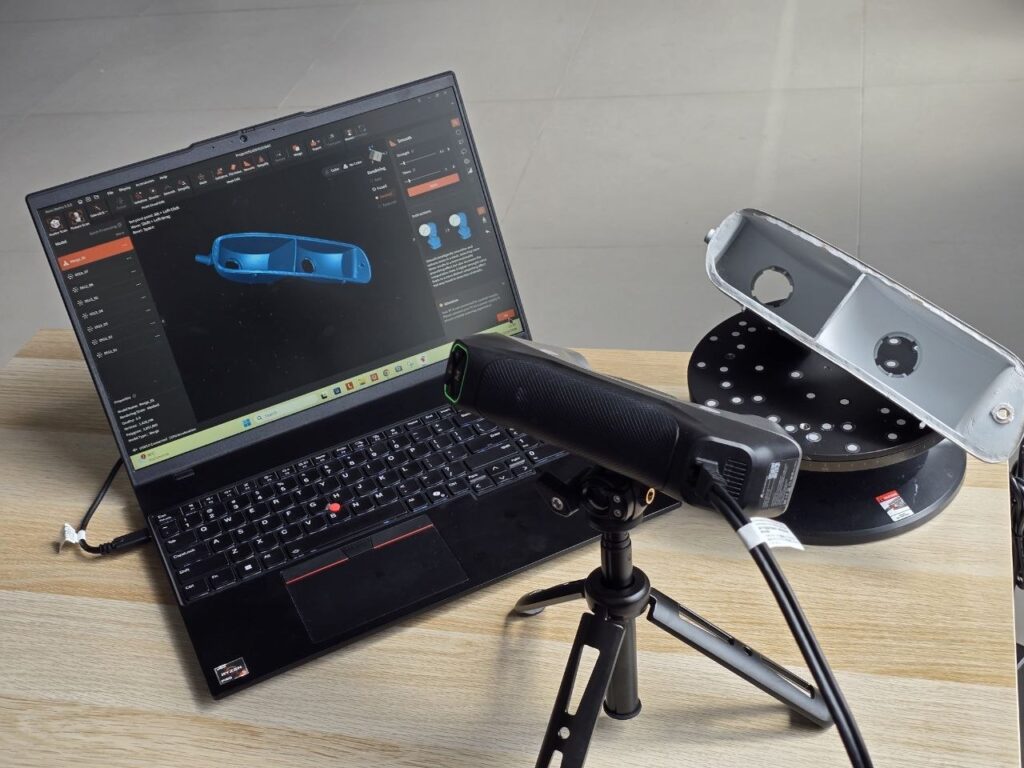
Before scanning begins, the part surface is prepared. Where necessary, adhesive reference targets are applied — these act as spatial anchor points that allow the scanner to register each new frame relative to the previous one. The headlight is positioned on a turntable equipped with a grid of reference markers, enabling automatic frame-to-frame alignment.
For glossy or transparent surfaces — common in modern headlight lenses — a temporary matte scanning spray is applied. It is easily removed after scanning without damaging the part.
Point Cloud Capture
The scanner moves around the object, capturing millions of data points per second. Dedicated software renders the emerging 3D model in real time on a laptop screen — exactly the workflow shown in photos from our production floor. The blue colour-rendered preview on screen indicates that the algorithm has already successfully registered the geometry across the majority of the object.
For complex parts with internal cavities or undercuts, scanning is performed in multiple orientations, and the individual scans are then merged into a single unified model.
Post-Processing and Surface Reconstruction
The raw scan output is a polygonal mesh that may contain noise, artefacts and gaps. Our engineers carry out:
- Noise filtering and removal of redundant data points
- Hole filling to close gaps in the mesh
- Surface smoothing without loss of geometric accuracy
- Conversion to STEP or IGES format for further editing in SolidWorks
For more detail on our CAD capabilities, visit the CAD modelling in SolidWorks page — this is where the point cloud becomes a fully parametric, production-ready model.
From Digital Model to Physical Part: Choosing the Right Material
Once a high-quality 3D model of the headlight or its components is in hand, the next question is: which material to print in? The answer depends on the functional requirements, operating environment and dimensional tolerances needed.
ASA — the Optimal Choice for Exterior Automotive Parts
ASA (Acrylonitrile Styrene Acrylate) is one of the best materials for outdoor automotive applications. Its key advantages include:
- High UV resistance — the part does not yellow or become brittle under prolonged sun exposure
- Operating temperature up to 95–100°C, which is critical for components near the engine or lighting assemblies
- Good chemical resistance to oils, fuel and technical fluids
- Excellent suitability for sanding and painting to achieve an OEM-quality surface finish
For headlight housings, optic mounting brackets and decorative exterior trim, ASA is our first-choice material at DRUKEX.
ABS — a Proven Option for Complex Geometries
ABS (Acrylonitrile Butadiene Styrene) is a well-established engineering material with strong mechanical properties. It can be acetone-smoothed for bonding and surface finishing, enabling a near-injection-moulded surface quality. However, ABS is less UV-stable than ASA, making it better suited to interior components or parts shielded from direct sunlight.
PETG and Nylon for Functional Components
PETG offers excellent impact resistance and ease of printing, while Nylon (PA12) delivers the highest mechanical strength among standard FDM materials. Nylon is particularly well-suited to brackets, bushings and connectors that are subject to cyclical mechanical loading.
A detailed overview of all available materials and their properties is available on the 3D printing materials page — including comparison tables and application-specific recommendations.
Case Study: Reproducing a Headlight Housing for a Classic Car
Here is a typical scenario that brings clients to us from across Poland.
Brief: The owner of a 1980s classic car needs a replacement headlight housing cover that has been out of production for decades. The original part exists but is cracked.
Step 1 — 3D Scanning. The original part is delivered to our workshop in Siemianowice Śląskie. A full scan is performed at 0.1 mm accuracy. Scanning time: 1–2 hours depending on geometry complexity.
Step 2 — Model Processing. The raw mesh is cleaned up and defects in the original part (cracks, scratches) are corrected in the CAD environment. If the client requests it, engineering improvements are incorporated at this stage.
Step 3 — Material Selection and Printing. ASA is selected for this exterior application. The part is printed on an industrial FDM printer with optimised infill parameters and build orientation for maximum structural strength.
Step 4 — Post-Processing. The part is sanded, primed and painted to match the vehicle’s body colour. The result is a component that is visually and functionally indistinguishable from the original.
Similar completed projects — spanning automotive and industrial components — are available to browse in our portfolio.
Scan Accuracy vs. Print Accuracy: What You Need to Know
One of the most common questions from clients is: “How dimensionally accurate will the reproduced part be?” The answer depends on two independent factors.
3D Scanning Accuracy
Modern handheld scanners such as the Revopoint or Shining3D EinScan series achieve accuracy from 0.05 to 0.1 mm. For the vast majority of automotive parts, this is more than sufficient. Critical mounting dimensions — hole diameters, seating surfaces — are verified with callipers where necessary and corrected in the CAD model.
FDM Printing Accuracy
FDM (Fused Deposition Modelling) technology delivers dimensional accuracy of ±0.2–0.3 mm under standard parameters. For tight-tolerance fits and interfaces, parts are printed with machining allowance and then finished by drilling, reaming or milling.
At DRUKEX, we also offer CNC milling as a complement to additive manufacturing — combining the design freedom of 3D printing with the dimensional stability of subtractive machining for critical surfaces.
3D Scanning as a Quality Control Tool
Beyond reverse engineering, 3D scanning is widely used for dimensional verification of manufactured parts. After printing, the finished part is re-scanned and the software compares the captured geometry against the source CAD model, generating a full-colour deviation map.
This approach is particularly relevant for:
- Series production — where dimensional consistency across batches must be monitored
- Rapid prototyping — to confirm that a prototype meets the engineering specification
- Safety-critical components — where tolerances are essential to safe assembly function
Further details about our 3D scanning services are available on the dedicated service page.
Why Choose DRUKEX for Automotive Projects
We serve both B2B and B2C clients from across Poland, with a strong concentration of industrial partners and workshops in Upper Silesia — Katowice, Chorzów, Bytom, Gliwice, Zabrze and surrounding cities.
Our competitive advantages:
- Full in-house workflow — 3D scanning, CAD modelling, 3D printing, post-processing
- Automotive expertise — we understand the specific requirements of vehicle-grade components
- Broad material portfolio — from PLA to ASA, Nylon and TPU
- Scalable production — from a single prototype to short-run series
- Fast turnaround — most projects completed within 3–7 business days
- Transparent pricing — detailed quotation provided before work commences
For clients requiring 3D prototypes or low-volume production runs, we offer a fully integrated approach: from an initial concept or physical part through to a finished, ready-to-install component.
When Is 3D Scanning the Right Choice?
3D scanning combined with additive manufacturing is not always the lowest-cost solution. But in certain situations, it is either the only viable option or clearly the most efficient:
✅ The part has no existing digital documentation (classic vehicles, legacy industrial equipment)
✅ An original part exists but an exact copy or modified version is needed
✅ Rapid reproduction is required without lengthy manual CAD modelling
✅ Quality verification of manufactured parts is needed
✅ The client wants to minimise design risk when no original drawings exist
If your project matches even one of these criteria, 3D scanning at DRUKEX can save you both time and money.
Request a 3D Scan and Print Quotation
Do you have a headlight housing, bracket, enclosure or any other part that needs to be reproduced or documented? Contact us — we will provide free initial consultation on the best approach and prepare a detailed quotation.
📍 We are based in Siemianowice Śląskie and serve clients across Poland.
👉 Complete the form on the quotation page or call us directly. The first step towards restoring your part takes no more than five minutes.