
3D Printing from a Photo: From Image to Finished Part
Imagine you have nothing but a photograph — an old logo, a decorative figurine, a sports trophy, or a worn component that needs to be reproduced. No technical drawings, no CAD files. Just a smartphone snapshot. Can that be enough to produce a high-quality part using 3D printing?
The answer is yes. And it is precisely what we do every day at DRUKEX.
This article explains how the photo-to-part workflow operates, what types of components can be manufactured this way, which materials are best suited for each application, and how long the full production cycle takes — from sending your image to receiving the finished product.
How the Workflow Operates: From Photo to Finished Part
Many clients assume that ordering 3D printing requires a ready-made STL or STEP file. In practice, that is not the case. Our team at DRUKEX regularly receives requests with a straightforward brief: “Here is a photo — please replicate this.”
The process follows four structured steps:
Step 1. Photo Analysis
Once we receive your image, a specialist evaluates the geometry of the object, its proportions, key surface features, and likely dimensions. The more angles you can provide, the more accurate the resulting model will be. That said, even a single sharp photograph is a sufficient starting point.
Step 2. CAD Modelling in SolidWorks
The next stage is CAD model design in SolidWorks. Our engineers reconstruct the object in three-dimensional space, maintaining the proportions visible in the photograph. Where necessary, we clarify specific details with the client — exact dimensions, wall thickness, hole patterns, or slot geometry.
Depending on the complexity of the form, this stage takes anywhere from a few hours to one or two working days.
Step 3. Model Approval
Before production begins, we send the client a render or screenshot of the 3D model for sign-off. This allows corrections to be made before any material is consumed. The majority of projects are approved on the first iteration or after minor adjustments.
Step 4. FDM Printing and Post-Processing
Once approved, the model goes to FDM 3D printing. Print time ranges from a few hours to a full day depending on part size and geometry. Post-processing follows: support removal, surface sanding where required, and bonding of multi-part assemblies.
Real-World Example: A Sports Trophy Reproduced from a Photo
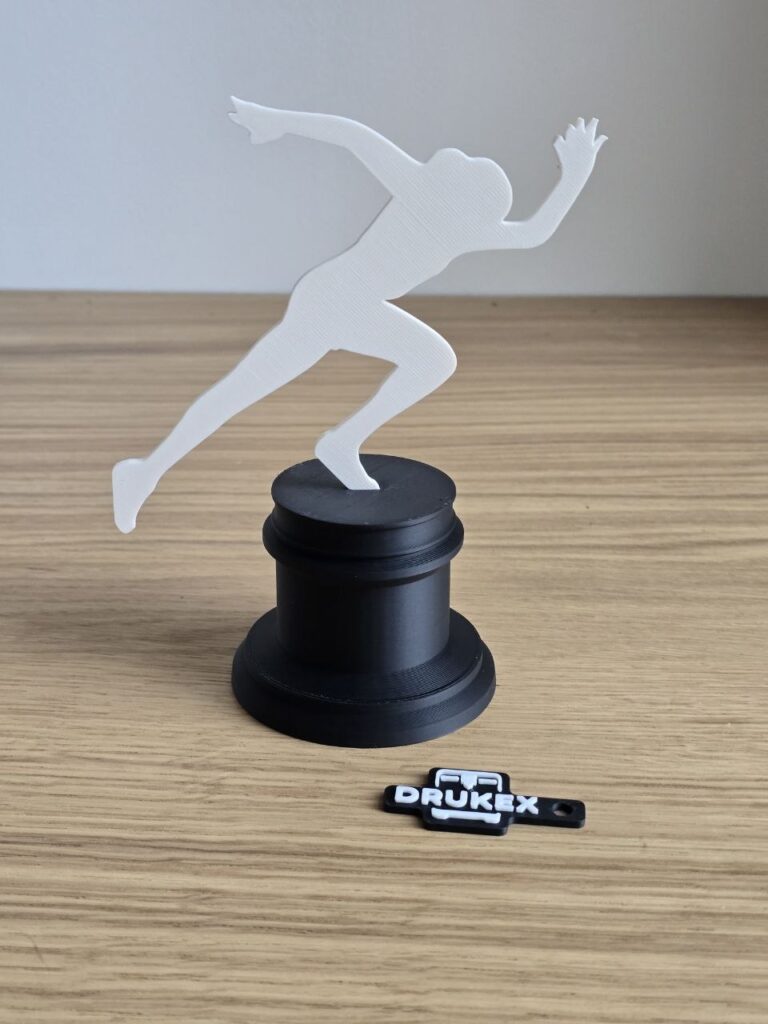
A recent project came from the organiser of an amateur running competition. He sent us a photograph of a trophy he liked and asked us to produce a series of similar awards for participants.
The result was an elegant sports trophy assembled from two components:
- Black cylindrical base (PLA, black) — a three-tier form with a textured side profile that delivers the classic look of a competition award
- White runner silhouette (PLA, white) — a flat figure of an athlete captured in a dynamic starting pose, inserted into a slot at the top of the base
The contrast between black and white, the clean geometry of the silhouette, and the quality surface finish make this part genuinely striking. No complex mechanisms, no unnecessary cost — just an accurate reproduction of the client’s concept.
Why FDM and PLA for This Application?
For trophies, figurines, and decorative components, FDM (Fused Deposition Modelling) is the optimal technology:
- Cost-effective — particularly advantageous for small-series production
- Wide colour range — PLA and ABS/ASA materials are available in dozens of shades
- Adequate mechanical strength — more than sufficient for awards and display pieces
- High surface detail — at a layer height of 0.15–0.2 mm, the surface finish is clean and professional
For parts requiring enhanced strength or elevated temperature resistance, we work with alternative materials including ABS, ASA, PETG, and nylon.
What Can Be Manufactured from a Photo?
The range of parts that can be reproduced from a photograph is broader than most clients expect. Here are the most common categories we handle:
Awards and Trophies
- Sports cups and figurines
- Corporate awards with company branding
- Prizes for school competitions and sporting events
- Personalised commemorative gifts
For these applications, dual-colour printing (AMS technology) is particularly popular — it produces logos or text in a contrasting colour without any painting.
Replacement Parts and Functional Components
Clients frequently send photographs of broken parts — handles, brackets, clips, housings — and ask us to reproduce them. This is one of the most practical use cases for photo-based 3D printing, and it is especially relevant for:
- Legacy equipment for which original parts are no longer manufactured
- Imported machinery with no access to OEM spares
- Custom or non-standard components with no off-the-shelf equivalent
This workflow sits at the intersection of reverse engineering and rapid prototyping — and it is where 3D printing delivers its clearest business value.
Decorative Parts and Promotional Items
- Figurines, miniatures, and keyrings
- Interior décor produced from sketches or reference images
- Corporate merchandise and branded promotional items
- Cosplay elements and event props
Prototypes from Sketches
If you have a product idea — even in the form of a rough sketch or a photograph of a comparable object — we can produce a 3D prototype to validate the concept. This is significantly faster and more cost-efficient than traditional prototyping methods.
What Image Quality Is Required?
This is one of the most common questions from first-time clients. The straightforward answer is: the better the photo, the more accurate the model — but even a moderate-quality image is usually a workable starting point.
Ideal Scenario
- Several photographs from different angles (front, side, top)
- Even, diffuse lighting without harsh shadows
- A reference object of known size placed next to the part (a coin or ruler)
- Sharp focus on surface details
Acceptable Scenario
- One clear photograph from the primary angle
- Approximate dimensions provided in your message
- A brief description of any details not visible in the image
Complex Cases
If the geometry is highly complex, asymmetrical, or contains a large number of fine details, we may recommend 3D scanning as an alternative. 3D scanning produces an accurate digital replica of a physical object without manual modelling, and it is particularly well suited to reverse engineering workflows.
Lead Times: How Quickly Can We Deliver?
Speed is one of the defining advantages of our approach. The table below shows indicative lead times for typical orders:
| Part Type | Modelling | Printing | Total |
|—|—|—|—|
| Simple keyring / badge | 1–2 hrs | 1–3 hrs | 1 day |
| Trophy / figurine | 2–4 hrs | 3–8 hrs | 1–2 days |
| Mechanical replacement part | 3–8 hrs | 2–6 hrs | 2–3 days |
| Complex prototype | 1–3 days | 4–24 hrs | 3–5 days |
For urgent orders, priority production is available — please specify your deadline when submitting your request.
Materials: Choosing the Right Option for Your Part
Material selection depends on the intended application. Here is a concise overview of the most commonly used options for photo-based production:
PLA — For Decorative Parts and Awards
PLA (polylactic acid) is the most widely used material for decorative applications. It machines and finishes easily, is available in a broad range of colours, and produces clean, precise surfaces. Ideal for trophies, figurines, promotional items, and exhibition models.
Limitation: not suitable for parts exposed to temperatures above 60 °C or significant mechanical loads.
ABS and ASA — For Functional and Outdoor Parts
ABS (acrylonitrile butadiene styrene) offers greater strength and higher temperature resistance than PLA. It is well suited to replacement parts, enclosures, and functional components. ASA shares similar mechanical properties but adds excellent UV and weather resistance, making it the preferred choice for outdoor applications. Both materials require slightly more controlled print conditions but deliver superior mechanical performance.
PETG — The Versatile Mid-Range Option
PETG combines the printability of PLA with improved strength and chemical resistance. An excellent choice for parts operating in more demanding environments where PLA would be marginal and ABS/ASA is not yet required.
TPU — For Flexible Elements
TPU (thermoplastic polyurethane) is a flexible, rubber-like material used for keyrings, protective covers, vibration-damping components, and seals.
A full overview of available materials and their specifications is available on our 3D printing materials page.
Why Clients Choose DRUKEX
We are based in Siemianowice Śląskie, in the heart of Upper Silesia, and serve clients across Poland. Here is what sets us apart:
End-to-end turnkey service — from photograph to finished part. There is no need to source a designer separately from a manufacturer. Everything happens under one roof.
In-house engineering team — experienced SolidWorks specialists who know how to extract precise geometry from photographic references and translate it into accurate 3D models.
Scalable production — whether you need a single prototype or a batch of several dozen units, we adapt the process to your requirements. Learn more about our small-series manufacturing capability.
Fast response times — we respond to enquiries within a few hours during business hours.
Transparent pricing — modelling and print costs are agreed upfront, with no hidden charges.
Practical Advice for First-Time Clients
If you have never ordered photo-based 3D printing before, here are a few tips that will help the project run smoothly:
- Submit multiple photos — even if quality is imperfect, different angles help our engineers understand the geometry
- Provide dimensions — even approximate figures (height, width, depth) are helpful
- Describe the intended use — this helps us select the most appropriate material
- Specify the quantity — unit cost decreases at higher volumes
- Ask questions freely — our team is happy to advise on both the possibilities and the constraints of each approach
Conclusion
Photo-based 3D printing is no longer a niche capability — it is an accessible, fast, and practical production method for everything from sports trophies to functional replacement parts. All you need is a clear idea and a few good photographs.
The DRUKEX team will take your image and deliver a finished part in the shortest possible lead time. We work with clients across Poland and provide a complete production cycle — from CAD modelling through to delivery.
Have a photo of a part you need reproduced? Send it to us and we will prepare a free preliminary assessment today.