
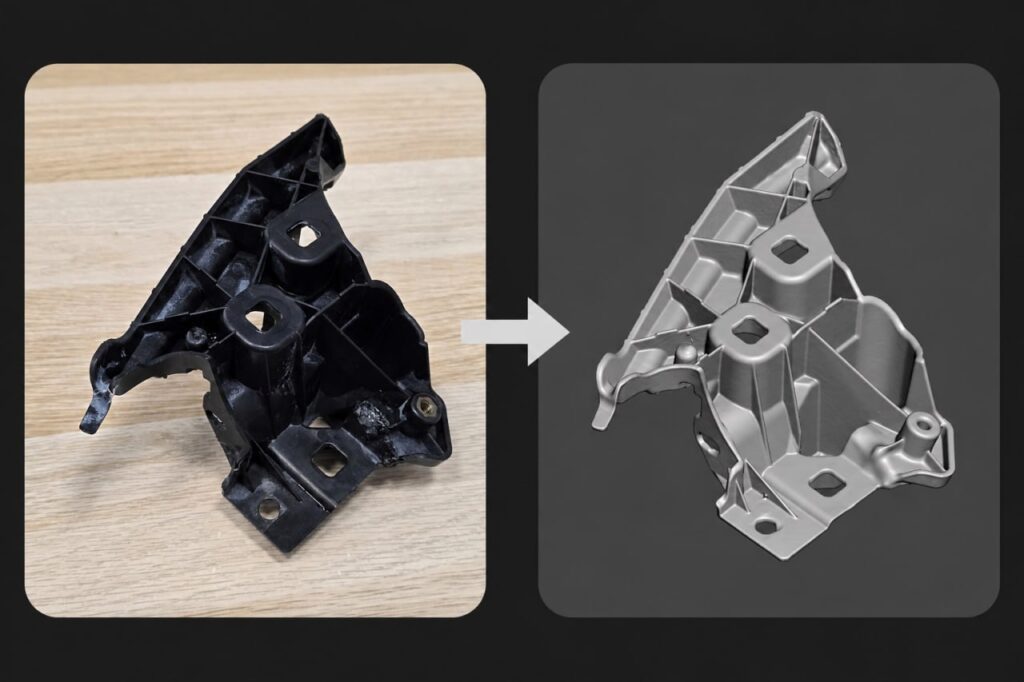
3D Scanning & Part Recovery: ASA, PETG, Nylon
Picture a common scenario in industrial maintenance: a critical machine component fails, the original manufacturer discontinued it years ago, and no compatible replacement is available on the market. Or the reverse — you have a physical part but no technical documentation, no drawings, and no CAD file to work from.
This is exactly where reverse engineering combined with professional 3D scanning delivers real value.
At DRUKEX, we offer a complete end-to-end service: from high-accuracy 3D scanning of a physical object, through geometry reconstruction and CAD modelling, to manufacturing the finished part via 3D printing using engineering-grade materials — ASA, PETG, Nylon, and more. This workflow helps our B2B clients across Poland and Europe resolve real production and design challenges every day.
What Is 3D Scanning and Why Does It Matter?
3D scanning is the process of digitising a physical object to create an accurate digital representation of its geometry. The output is a point cloud or polygon mesh, which reproduces the shape, dimensions, and surface characteristics of the original part with high precision.
This technology is widely applied across industries:
- Automotive — reconstruction of brackets, mounts, and body components
- Industrial machinery — replication of worn or damaged spare parts
- Medical & orthopaedics — production of custom prosthetics and orthotic devices
- Architecture & heritage preservation — documentation and replication of unique structures
- Electronics — enclosures, mounting brackets, and assembly components
Unlike traditional measurement with callipers or a ruler, a 3D scanner captures millions of data points simultaneously, achieving accuracy down to a tenth of a millimetre. This is particularly important for complex geometries — parts with undercuts, reinforcing ribs, curved surfaces, and holes across multiple axes.
Scanning Technologies We Use
At DRUKEX, we apply modern scanning methods that deliver high-quality digital results even for complex or challenging objects:
- Structured light scanning — high accuracy for small and medium-sized components
- Photogrammetry — efficient for medium and large objects
The choice of method depends on the object’s size, required accuracy, and surface material. Our engineers will recommend the most suitable approach for your specific project.
Geometry Reconstruction: From Raw Mesh to a Production-Ready CAD Model
The polygon mesh produced by 3D scanning is only the first step. A raw mesh frequently contains noise, surface defects, or inaccuracies caused by:
- Reflective or complex surface textures
- Partial occlusion during scanning
- Physical damage or wear on the original part
- Limited scanner access to certain areas
That is why mesh processing and geometry reconstruction is just as critical as the scanning itself. Our engineers work with the captured data in specialist software — cleaning the mesh, filling gaps, and preparing a clean model ready for the next stage.
From Mesh to Parametric CAD Model
For many applications, the cleaned polygon mesh is sufficient and can be sent directly to the 3D printer. However, where full engineering documentation is required — or where the design needs to be scaled, modified, or adapted — we carry out reverse engineering in SolidWorks: converting the mesh into a fully parametric CAD model with precise dimensions, sketches, and edit capability.
This is especially valuable when a client wants not just a copy of a part, but an improved version — for example, changing the material grade, adding reinforcing ribs, or adapting mounting features to new installation conditions. Learn more about our capabilities in this area on the CAD modelling in SolidWorks page.
Practical Example: Mounting Bracket — From Scan to Finished Part
A typical project that illustrates the full process well: a client brings in a mounting bracket — a complex component with multiple fixing planes, reinforcing ribs, and holes across different axes. The original part was injection-moulded from ABS or polyamide, is no longer in production, and cannot be sourced anywhere on the market.
Stage 1 — 3D Scanning: The object is positioned in the scanning area and fully scanned from all sides. Output: a detailed polygon mesh with accuracy of ±0.1 mm.
Stage 2 — Data Processing: Engineers clean the mesh, remove noise and artefacts, and verify the geometry against the original part.
Stage 3 — Reverse Engineering (if required): If the client needs a CAD file for their own documentation or further modifications, retopology is performed and a parametric model is built in SolidWorks.
Stage 4 — 3D Printing: The finalised model is imported into the slicer, the optimal material and print parameters are selected, and the part is manufactured on an industrial FDM printer.
Stage 5 — Post-Processing & Quality Control: The finished part is checked against the original dimensions; surface finishing is applied where required.
The full cycle — from receiving the original part to delivering the finished component — typically takes 3 to 7 business days, depending on complexity and the services selected.
Materials for 3D Printing Recovered Parts: ASA, PETG, Nylon and More
One of the key factors in successfully reproducing functional components is selecting the right material. At DRUKEX, we specialise in engineering-grade polymers that match or approach the performance characteristics of traditional structural materials.
A full overview of all available materials is available on our 3D printing materials page. Below, we focus on the most commonly used options for recovered and replicated parts.
ASA — For Outdoor and Weather-Resistant Applications
ASA (Acrylonitrile Styrene Acrylate) is the material of choice when ABS-like properties are needed for parts exposed to outdoor conditions. Key advantages:
- Excellent UV resistance — does not yellow or become brittle under prolonged sun exposure
- Good mechanical strength and rigidity
- Heat resistance up to 95–100°C
- Good chemical resistance to oils and mild solvents
ASA is ideal for automotive brackets, exterior mounts, outdoor equipment housings, and any component subject to weathering.
PETG — The Versatile Choice for Functional Parts
PETG (Polyethylene Terephthalate Glycol) is one of the most popular engineering materials in our portfolio. It combines:
- Good impact resistance and flexibility
- Resistance to moisture and most chemicals
- Operating temperature up to 80°C
- Excellent interlayer adhesion, producing near-isotropic mechanical properties
- Ease of processing with minimal warping during printing
PETG is an excellent choice for enclosures, brackets, inserts, and components not exposed to extreme temperatures or aggressive chemicals.
Nylon (PA) — For High-Load Applications
For parts operating under impact loads, vibration, and friction, Polyamide (Nylon) is the optimal choice. This material offers:
- Outstanding impact toughness and resistance to dynamic loads
- Natural abrasion resistance — ideal for moving joints and sliding components
- Good chemical resistance
- Operating temperatures up to 120°C
Nylon is particularly valued in mechanical engineering and the automotive sector — precisely the industries where the need to reproduce discontinued spare parts arises most frequently.
ABS and Other Materials
For parts requiring surface post-processing (sanding, acetone smoothing, painting), we also work with ABS. Our material portfolio additionally includes PC (Polycarbonate) for parts demanding impact resistance combined with optical clarity, and TPU for flexible or vibration-dampening components.
Industry Applications and Typical Project Types
3D scanning and reverse engineering services are in demand across a wide range of sectors. The following are the most common project types we handle for B2B clients from the Silesia region and across Poland:
Automotive & Motorsport:
Reconstruction of discontinued brackets, mounts, and interior components. Particularly relevant for owners of classic or rare vehicles, and for motorsport teams requiring bespoke fitment solutions.
Industrial Maintenance:
Replication of worn conveyor parts, machine components, and pneumatic or hydraulic system elements. Frequently a faster and more cost-effective alternative to ordering from the original equipment manufacturer.
Medical & Rehabilitation:
Production of custom orthopaedic aids and adapters for medical equipment.
Electronics & Instrumentation:
Custom enclosures for non-standard devices, mounting brackets, and protective covers.
Architecture & Design:
Replication of decorative architectural elements and restoration of damaged heritage components.
To see examples of completed projects, visit our project portfolio.
Small-Batch Production: From Single Prototype to Production Run
A key advantage of combining 3D scanning with 3D printing is the ability to produce small batches of identical parts without the need for expensive tooling or injection moulds. Whether you need 1, 10, 50, or 200 identical components, our industrial FDM printers are equipped for reliable small-series production.
This is especially relevant for manufacturers requiring maintenance spare parts for existing equipment, or functional prototypes for validation testing ahead of full-scale production. More details are available on the small-series production page.
Why Choose DRUKEX for 3D Scanning and Part Recovery?
We understand that every project is unique. At DRUKEX, we do not work from templates — every order receives individual attention from an experienced engineering team.
Our key advantages:
- Complete workflow under one roof — 3D scanning, data processing, CAD modelling, and 3D printing without the need to coordinate multiple suppliers
- Engineering expertise — our team understands not only the printing process, but also the structural and functional requirements of each part
- Broad material selection — ASA, PETG, Nylon, ABS, PC, TPU, and other technical polymers
- Scalability — from a single rapid prototype to small-batch serial production
- Local presence — based in Siemianowice Śląskie, serving clients from Katowice, the wider Silesia region, and across Poland
- Fast turnaround — most orders completed within 3–7 business days
Our 3D printing services in Katowice and the region are available for both one-off orders and ongoing B2B partnerships.
How to Get Started
The ordering process is straightforward:
- Contact us — describe your requirement and send photos or a description of the object
- Receive a consultation — our engineer will assess the project complexity and recommend the optimal solution
- Agree on cost and timeline — we will prepare a tailored quote
- Send or deliver the object — in person or by courier to our facility in Siemianowice Śląskie
- Receive the finished part — scanned, modelled, and 3D printed to your specifications
Ready to get started? Complete the form on our quote request page or contact us directly — we respond within one business day.
DRUKEX — professional 3D printing and reverse engineering services in Siemianowice Śląskie, Poland. Serving B2B and B2C clients across Poland and Europe.